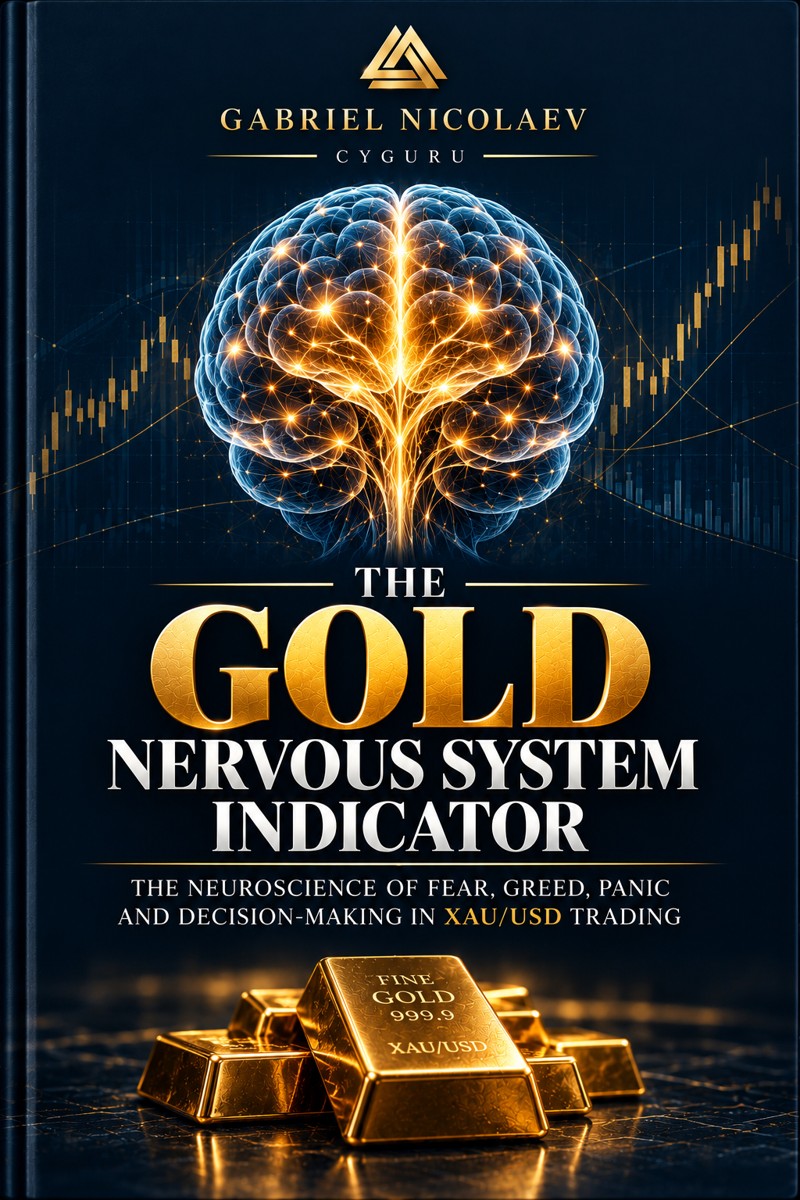
The Gold Nervous System Indicator
The Neuroscience of Fear, Greed, Panic and Decision-Making in XAU/USD Trading
Study how stress, uncertainty and emotional responses influence risk perception and decision-making in the gold market.
View book & buying options on CyGuru.com ↗Inside the book
This book explores the relationship between the human nervous system and financial decisions. Its subject is the trader who perceives risk, experiences uncertainty and responds to changing prices.
Bringing together neuroanatomy, neurophysiology, behavioral finance and decision science, it examines questions familiar to traders: why a loss can provoke panic, why profits are sometimes closed too early and why a prepared strategy can be abandoned under pressure.
The scientific and educational discussion offers a framework for understanding behavior around XAU/USD. Nervous system awareness is presented as a subject of study, not evidence that neurological measurements can reliably predict gold-price direction.
Examine the person making the financial decision
The Gold Nervous System Indicator studies the human side of participation in the gold market. Financial uncertainty is perceived and processed by a person whose attention, expectations and emotional state can change. The book considers how those changes influence the experience of risk and the actions taken in response.
The title refers to a scientific and educational exploration of trading behavior. It should not be confused with a downloadable price indicator or an automatic signal service. Its central question concerns the relationship between nervous-system processes and decision-making in XAU/USD.
Connect neuroscience with behavioral finance
The book brings together neuroanatomy, neurophysiology, behavioral finance and decision science. These subjects approach the same practical problem from different angles: how a human being responds when an uncertain outcome has financial and emotional significance.
Readers are introduced to a framework for examining reactions rather than merely labeling them as a lack of discipline. Fear, greed and panic are considered in relation to perception and choice. This gives the discussion a broader scope than a list of motivational instructions to remain calm or think positively.
Explore stress, uncertainty and changing risk perception
A trader can prepare a strategy in one state and attempt to execute it in another. The book explores the kinds of problems that arise around that difference: abandoning a plan during volatility, reacting impulsively to news or experiencing a loss as an urgent demand to act.
The focus is on understanding behavior around financial uncertainty. It invites readers to distinguish the external event from their response to it and to consider how that response may influence interpretation. A strong feeling about the market is not, by itself, evidence about the market’s next movement.
Investigate the decisions that undermine a plan
Closing a profitable position too early, keeping a losing position open and entering impulsively are among the questions raised by the book’s presentation. These actions can be examined as decisions with immediate emotional consequences as well as financial ones.
Studying the mechanisms behind such choices can support a more precise review. Instead of writing only that a trade was emotional, a reader can investigate what was being perceived, what uncertainty was difficult to tolerate and where the intended process changed. That distinction makes the subject relevant to both preparation and reflection.
Use the book as a foundation for deeper study
This title is suited to readers who want to explore the biological and psychological foundations of trading behavior. It can complement a technical handbook by directing attention to the person interpreting its information and applying its rules.
The scope remains educational. The book does not establish that neurological measurements can reliably predict gold-price direction, and its discussion should not be treated as individualized clinical advice. For a more immediate decision-focused companion, Before You Click develops the practical question of what to do at the moment an order is being considered.
What you will explore
- Stress and financial risk perception
- Fear, greed and panic
- Behavioral finance and decision science
- The human side of XAU/USD
Who this book is for
Readers interested in the biological and psychological mechanisms behind trading behavior.
Frequently asked questions
Is this a Pine Script indicator?
No. This page presents the book The Gold Nervous System Indicator, a study of neuroscience, trading psychology and financial decision-making.
Does it claim that the nervous system predicts gold prices?
No. Its product description explicitly distinguishes the educational discussion from claims that neurological measurements reliably predict gold-price direction.
How does it differ from Before You Click?
This book focuses on the broader biological and psychological mechanisms. Before You Click concentrates on practical checks around individual trading actions.
Explore the official edition
Find The Gold Nervous System Indicator by Gabriel Nicolaev – CyGuru on the author’s official store.
View The Gold Nervous System Indicator on CyGuru.com ↗Current editions, formats, pricing and availability are listed on CyGuru.com.